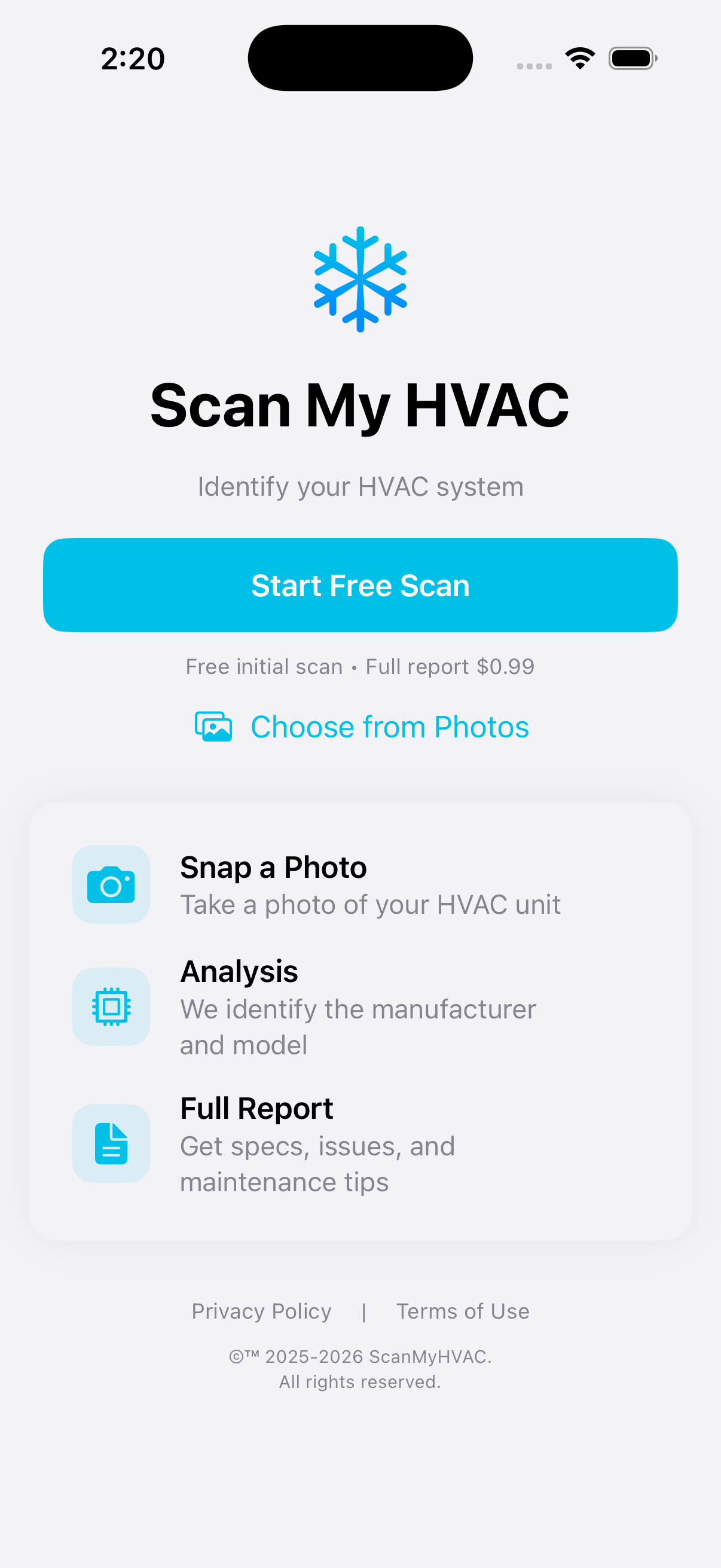
Snap a photo of any air conditioner, heat pump, or furnace and receive manufacturer details, specifications, efficiency ratings, and maintenance recommendations.
Free to scan. Full reports just $0.99
Whether you're an HVAC technician, property manager, or homeowner, Scan My HVAC gives you the information you need.
Photograph any air conditioner, heat pump, or furnace and get manufacturer and model details in seconds. Works with all major brands.
Get SEER, EER, HSPF, and AFUE ratings for your equipment. Understand your system's energy efficiency and potential savings.
Receive model-specific maintenance recommendations to keep your HVAC system running efficiently and extend its lifespan.
Learn about known problems and failure points for your specific model. Be proactive about repairs before breakdowns occur.
Trusted by HVAC technicians, property managers, and homeowners nationwide. Quick identification for service calls, quotes, and maintenance planning.
Get HVAC information in three simple steps
Snap a picture of your HVAC unit or its rating plate using your phone camera or choose an existing photo from your library.
The image is analyzed to identify the manufacturer, model, and type of HVAC equipment.
Receive a free identification summary or unlock the full report with specs, issues, and maintenance tips for $0.99.
Start scanning for free. Pay only when you need the full details.
Understanding the different types of HVAC systems and their efficiency ratings
Split systems with an outdoor condenser and indoor evaporator coil. Most common in homes with existing ductwork. Rated by SEER (Seasonal Energy Efficiency Ratio)—higher is better. Modern units range from 14-26 SEER.
Provide both heating and cooling by transferring heat. More efficient than traditional furnaces in moderate climates. Rated by both SEER (cooling) and HSPF (Heating Seasonal Performance Factor).
Ductless systems with individual indoor air handlers. Ideal for room additions, older homes without ducts, or zone control. Can be single-zone or multi-zone configurations.
Heat air using natural gas or propane combustion. Most common heating system in colder climates. Rated by AFUE (Annual Fuel Utilization Efficiency)—modern units achieve 90-98% AFUE.
All-in-one systems with heating and cooling in a single outdoor cabinet. Common in commercial buildings and homes without basements. Available in electric, gas, or hybrid configurations.
SEER: Cooling efficiency (14+ required, 20+ is excellent)
EER: Cooling efficiency at peak conditions
HSPF: Heat pump heating efficiency (8+ is good)
AFUE: Furnace efficiency percentage (90%+ is high efficiency)
Common questions about HVAC systems and Scan My HVAC
The model number is typically found on a metal rating plate attached to the unit. For outdoor condensers, check the side panel. For furnaces, look inside the front panel or on the side. For air handlers, check the access panel. The plate contains the model number, serial number, and key specifications. Scan My HVAC can identify your equipment even from a photo of the entire unit.
SEER (Seasonal Energy Efficiency Ratio) measures air conditioner and heat pump cooling efficiency. It's calculated by dividing cooling output by energy input over a typical cooling season. Higher SEER means lower energy bills. Minimum SEER is 14 for most regions (15 in southern states). High-efficiency units reach 20-26 SEER. A unit with 20 SEER uses about 30% less energy than a 14 SEER unit.
Lifespan varies by equipment type and maintenance. Air conditioners and heat pumps typically last 15-20 years. Gas furnaces can last 15-30 years. Boilers often exceed 20 years. Factors affecting longevity include usage patterns, maintenance frequency, installation quality, and local climate. Regular filter changes and annual professional maintenance can significantly extend equipment life.
R-22 (Freon) was phased out in 2020 due to ozone depletion concerns. R-410A (Puron) is the current standard, operating at higher pressures and offering better efficiency. If your unit uses R-22, repairs requiring refrigerant will be expensive as R-22 supplies are limited. Units manufactured after 2010 use R-410A. Scan My HVAC identifies refrigerant type to help you understand repair implications.
HVAC sizing is measured in tons (1 ton = 12,000 BTU/hour). Proper sizing requires a Manual J calculation considering square footage, climate, insulation, windows, and more. Rough estimate: 1 ton per 400-600 sq ft in moderate climates. Oversized units cycle too frequently; undersized units run constantly. Both waste energy and reduce comfort. Always have a professional perform load calculations.
Standard 1" filters: every 1-3 months. 4" media filters: every 6-12 months. Factors requiring more frequent changes: pets, allergies, dusty environments, or heavy use. A dirty filter restricts airflow, forcing your system to work harder, increasing energy bills, and potentially causing damage. Check filters monthly and replace when visibly dirty.
Scan My HVAC identifies equipment from all major manufacturers including Carrier, Trane, Lennox, Rheem, Goodman, Daikin, York, Bryant, American Standard, Ruud, Amana, Coleman, Heil, Tempstar, Luxaire, Mitsubishi, Fujitsu, LG, Samsung, and many more. Our database covers both residential and light commercial equipment from current and legacy product lines.
The full report provides detailed specifications, efficiency ratings, refrigerant type, known issues for your specific model, and maintenance recommendations. This information helps you make informed decisions about repairs, maintenance, and replacement. For HVAC technicians, it saves time researching specs on service calls. For homeowners, it provides clarity when discussing options with contractors.
Start scanning now and get the information you need in seconds.